
A mother stopped me near the KG block gate last week. Her son is three and a half. She had read three different WhatsApp forwards about the new education policy and each one said something different. “Madam, will he have to do exams in Nursery now? Will he lose a year? Should we start tuition?” She looked tired, the way parents look when too many people are giving them advice at once.
So let us sit down together and keep it simple. Here is what the National Education Policy 2020 (NEP 2020) says about the early years, what it does not say, and what it means for your little one at home and in school.
The new 5+3+3+4 structure, in plain words
For many years we thought of school as starting at Class 1, at about age six, with the years before it treated as a warm-up. NEP 2020 changes that thinking. It replaces the old 10+2 pattern with a 5+3+3+4 pattern that starts at age 3:
- Foundational Stage (ages 3 to 8): three years of preschool (Nursery, LKG, UKG or Balvatika) plus Class 1 and Class 2.
- Preparatory Stage (ages 8 to 11): Classes 3 to 5.
- Middle Stage (ages 11 to 14): Classes 6 to 8.
- Secondary Stage (ages 14 to 18): Classes 9 to 12.
The big idea is this: the policy treats ages 3 to 8 as one single stage. Nursery is no longer a “before school” year. It is real school, just in a form that fits a small child.
Why the early years get so much attention
The policy notes that a very large part of brain development happens before a child turns six. Think about how much your child has learnt since birth without a single textbook: words in two or three languages, how to climb stairs, which aunt gives the best laddoos. That learning happened through play, talking, watching and trying again.
NEP 2020 asks schools to build on exactly that. It calls this Early Childhood Care and Education, and it wants every child to reach Class 1 ready to learn, not scared of it.
What learning should look like from ages 3 to 8
The National Curriculum Framework for the Foundational Stage, released in 2022, explains the policy in classroom terms. In short, it asks for learning that is:
- Play-based: blocks, puzzles, clay, sand, songs, rhymes and stories are the main tools, not worksheets.
- Activity-based: children learn counting by sorting buttons, and learn about plants by watering one every morning.
- Talk-rich: lots of conversation, in the home language where possible, so that children feel confident before they move to reading and writing.
- Gentle on assessment: no exams for small children. Teachers observe and note how each child is growing.
There is also a national push called foundational literacy and numeracy. The goal is simple: every child should be able to read with understanding and do basic number work by about Class 3. That is a goal for the school system, not a test for your three year old.
What this does NOT mean
Let me clear up a few of those WhatsApp worries:
- It does not mean exams in Nursery: in fact the opposite. The policy moves away from formal tests at this age.
- It does not mean tuition for toddlers: a three year old learns more from helping you knead atta than from a workbook.
- It does not mean your child is behind if they cannot write yet: holding a pencil properly takes time. Strong little fingers come first, from clay, tearing paper and buttoning shirts.
- It does not mean less learning: play is how young children learn. We wrote more about this in our blog on learning beyond textbooks.
What it looks like at Samar Global High School
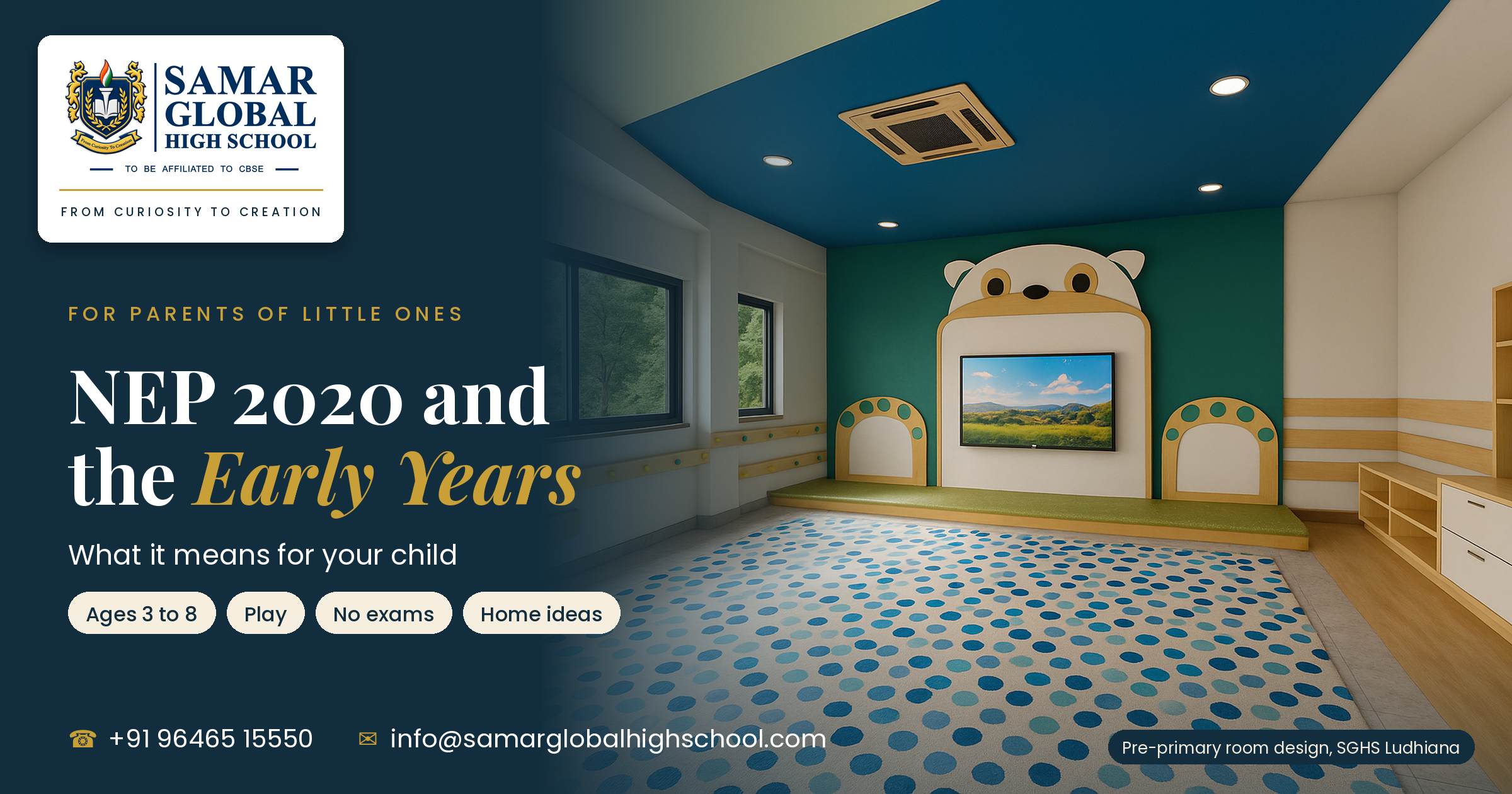
At SGHS our youngest learners are in Samar Angan (Nursery), Samar Pravesh (LKG) and Samar Sopan (UKG). The day is built the way the early years should be.
Mornings begin with circle time, where children greet each other, share one thing from home and settle their feelings. Our Toddler Corner and Indoor Sensory Zone let children explore textures, sounds and colours. The Science Park is an open-air space where a leaf, a shadow or a snail becomes a lesson. Clay work in our pottery studio builds the same small muscles a child later needs to hold a pencil.
Children also get early, playful exposure to French and Mandarin through songs and simple conversation, while we keep their home languages close. And instead of marks, each child has a digital portfolio that grows with them, with small pieces of work that show progress over time. You can read more on our academics page and curriculum page.
Picture a child in Samar Sopan sorting the class fruit basket by colour, then by size, then counting the apples aloud for her friends. Nobody calls it a maths lesson. It is one.
Simple things you can do at home
You do not need special kits. Try these this week:
- Talk while you work: while cooking, name things, count rotis, ask “what will happen if we add more water?”
- Read one story a day: in Punjabi, Hindi or English. Let your child turn the pages and guess what comes next.
- Give small jobs: setting spoons on the table, matching socks and watering plants all build counting, sorting and responsibility.
- Play outside every day: running, jumping and climbing help the body and the brain. Our blog on screen time for kids has more ideas for swapping screens with play.
- Ask, do not quiz: “Tell me about your drawing” opens a child up. “What colour is this?” ten times a day can close them down.
Choosing a school with the early years in mind
When you visit schools for Nursery admission, look past the building for a moment. Watch the children. Are they busy and chatty, or sitting silently over worksheets? Ask how the school tracks progress without exams. Ask how much time children spend outdoors. Our school visit checklist has more questions you can carry along, and the age criteria page explains which class fits your child. If you are still unsure whether your little one is ready to start, our post on 10 simple signs your child is ready for nursery can help.
Frequently asked questions
Does NEP 2020 make Nursery compulsory?
NEP 2020 brings ages 3 to 6 into the school structure and aims for every child to get good quality early education. It is best to check with your school and local rules for the class and age details that apply to your child.
Will my child have exams in Nursery or LKG under NEP 2020?
No. The policy and the foundational stage curriculum ask schools to avoid formal exams for young children. Teachers observe children while they play and learn, and share progress with parents.
Is Samar Global High School following NEP 2020 in the early years?
Our early years programme follows the play-based, activity-based approach that NEP 2020 describes, with circle time, sensory play, outdoor learning and digital portfolios in place of marks.
Come and see it for yourself
The best way to understand the early years is to watch them happen. Bring your child for a morning, let them touch the clay and peep into the Sensory Zone, and ask our teachers anything you like. Admissions for 2027-28 are open from Nursery to Class 5. Book a campus visit or see the admissions page for the steps. We would love to meet you both.