
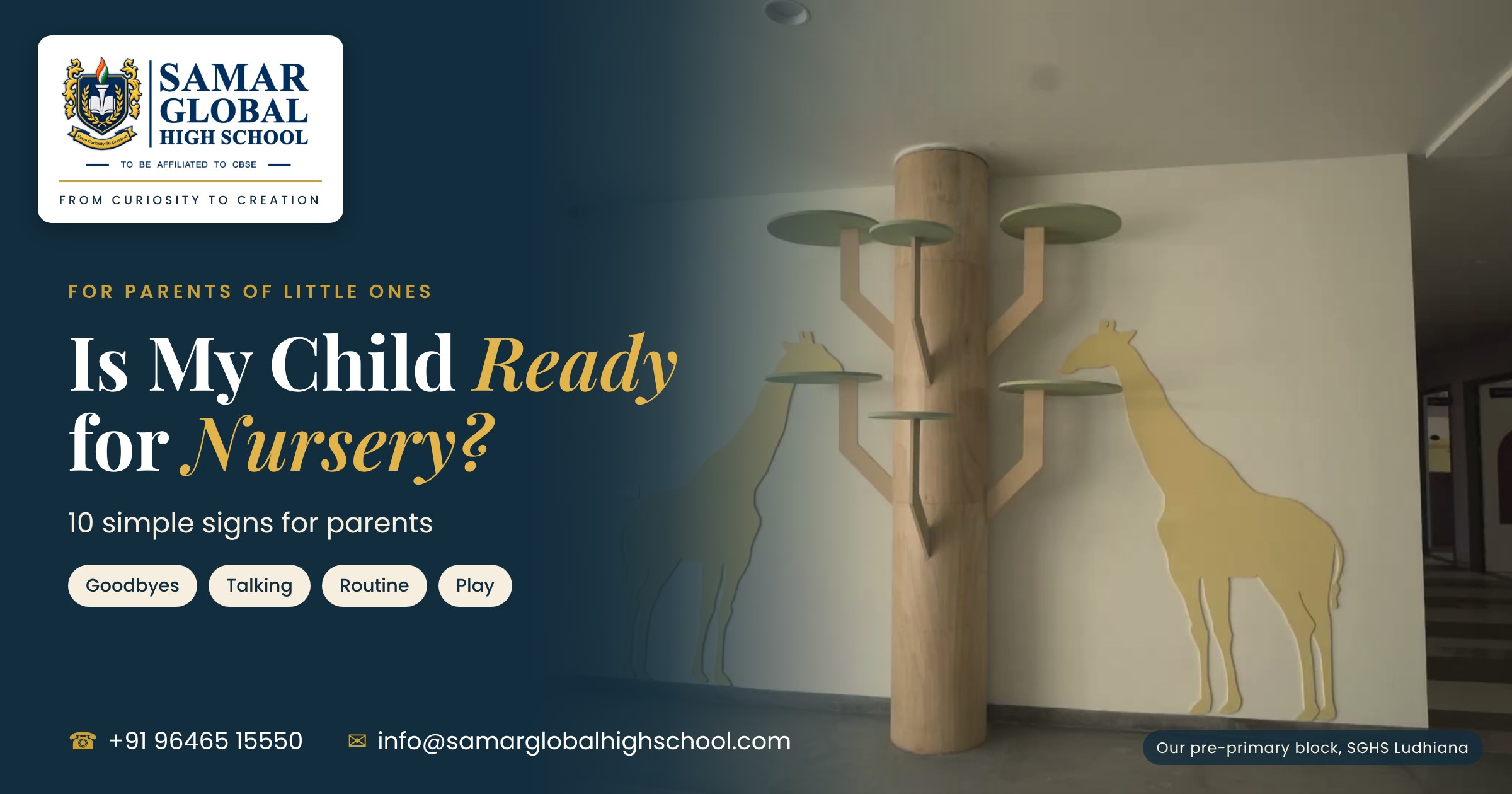

Every year around this time, a mother or father walks into our school office, holds their little one a bit closer and asks the same question: “Do you think she is ready for nursery?”
It is a good question, and a very honest one. Most parents in Ludhiana start thinking about nursery when their child is around two and a half or three. Relatives start asking. Neighbours share where their children have been admitted. And somewhere in all of this, a simple worry creeps in: what if my child is not ready?
Here is what our early years teachers tell every parent who asks. Being ready for nursery has very little to do with reciting A to Z or counting to fifty. It is about small, everyday things that help a child feel safe and curious in a new room full of new faces. Below are ten signs we look for, and a few easy ways to build each one at home.
1. Your child can stay away from you for a little while
If your child can spend an hour or two with Dadi, Nani, a chachi or a neighbour without getting too upset, that is a very good sign. Some tears at the school gate in the first few weeks are normal. We see them every year, and they usually stop sooner than parents expect.
Try this at home: practise short goodbyes. Always say bye, never slip away quietly, and come back exactly when you said you would. Children learn to trust that you will return.
2. Your child can tell someone what he/she needs
Full sentences are not needed. A word or a clear sign for “water”, “toilet”, “hungry” or “help” is enough for a teacher to understand.
Try this at home: when your child points at the water bottle, wait a few seconds before handing it over. Give him/her the chance to say the word.
3. Your child is learning to use the toilet
Most nursery children are toilet trained or close to it. Accidents still happen, and our teachers expect them. Nobody will make a fuss.
Try this at home: keep a regular toilet routine, and choose clothes your child can pull down and up without help. Elastic waists are your best friend this year.
4. Your child can follow one simple instruction
“Keep your shoes here.” “Bring your bottle.” A nursery child hears small instructions like these many times a day.
Try this at home: give one clear instruction at a time, and say well done when it is followed.
5. Your child is interested in other children
This does not mean your child already shares perfectly. Very few three year olds do. It means he/she watches other children, plays next to them and slowly starts to join in.
Try this at home: take your child to the park in the evening, or invite a cousin over to play. Let him/her be around other children, even if he/she just watches at first.
6. Your child can sit for a short story
Being able to sit and listen for five to ten minutes is a lovely sign.
Try this at home: read aloud every day, in whatever language your family speaks at home, English, Hindi or Punjabi. Stop in the middle and ask, “What do you think happens next?”
7. Your child asks a lot of questions
All those “why” and “what is this” questions at the dinner table can feel endless. They also mean your child is hungry for new things to learn.
Try this at home: answer simply, and sometimes turn it around: “What do you think?” You will be surprised by the answers.
8. Your child wants to do small things alone
Eating with a spoon, drinking from a cup, putting on a cap or opening a tiffin box. These little jobs build big confidence.
Try this at home: give your child time to try before you step in, even when it is slower and messier. Yes, there will be dal on the floor. That is part of it.
9. Your child has a regular daily routine
Children who sleep, wake and eat at roughly the same time each day settle into school faster.
Try this at home: about a month before school starts, slowly move bedtime and wake up time closer to school timings. Ten minutes earlier every few days works better than a sudden change.
10. Your child uses his/her hands and body freely
Scribbling with crayons, stacking blocks, running, climbing and jumping all build the small and big muscles a child needs later for writing and for sports.
Try this at home: atta dough or playdough, colouring, threading big beads on a string, and time outside every single day. If you are worried about screens taking up this time, our earlier post on screen time and young children has some simple ideas.
What if my child is not showing all ten signs?
Then your child is completely normal. Every child grows at his/her own pace, and nursery is exactly where many of these skills grow. We have seen shy children who would not let go of their mother on day one leading the morning prayer by the end of term.
The national education policy, NEP 2020, treats the years from three to eight as one foundational stage, and it asks schools to teach young children mostly through play, stories, songs and activities. That is how our Nursery, LKG and UKG classes work. Children learn to share, speak up and do things on their own without pressure. You can read more about this on our Academics page, or see why we care so much about learning outside the notebook in Learning Beyond Textbooks.
If you are also comparing schools right now, our school checklist for 2027-28 admissions may help you plan your visits.
Questions parents often ask us
What is the right age for nursery admission?
Age rules can change from year to year. Please check our current age criteria page or call our admissions team before you apply.
Should my child know the alphabet and numbers before nursery?
No. Nursery is where children begin these skills, through play, rhymes and stories. Please do not push writing practice at home before your child is ready.
How can I help my child on the first day?
Talk about school in a happy way for a few weeks before, visit the campus together if you can, keep the goodbye short and warm, and be on time for pick up. A familiar face at the gate means a lot.
If you think your child is ready, or you are not sure and want to talk it through, we are happy to help. Book a campus visit to see our pre-primary classrooms and play areas, or read about admissions 2027-28 for Nursery to Class 5.