
There is one question I hear in almost every admissions conversation with parents of three and four year olds. It usually comes with a small smile, “Madam, if the children play all morning, when will the real studies start?”
It is a fair question. Most of us grew up with slates, copies and a lot of rote learning. So when we picture children playing in school, a small voice inside says, “Is this a waste of time?”
Let me answer it the way I answer those parents. Play, when it is planned well, is real study. It just did not look like the study we remember.
What a block bridge can teach
Picture four Nursery children on the floor with a pile of wooden blocks, building a “bridge” so a toy cow can cross a river. In just ten minutes they will have to:
- Solve a problem: the first bridge falls down, so they make the base wider.
- Count and compare: “We need two more long blocks,” one girl says, and goes to find exactly two.
- Use language: they argue, explain, give instructions and listen.
- Share and take turns: only one child can place a block at a time.
- Keep going: when it falls the second time, nobody cries. They laugh and try again.
That is early maths, science, language and teamwork, all in one game. No worksheet can give a three or four year old that much in ten minutes.
Play is how small children learn
Young children do not learn by sitting still and listening for long. They learn by touching, moving, trying, talking and trying again. This is why the National Education Policy 2020 and the National Curriculum Framework for the Foundational Stage (2022) both ask schools to make play and activity the heart of learning from age 3 to 8. The Ministry of Education even released a learning kit for this stage called Jaadui Pitara, full of toys, puppets, stories and games.
We wrote about what the policy means for families in our blog on NEP 2020 and the early years. The short version is simple: for young children, play is not a break from learning. Play is the learning.
Not all play is the same
When our teachers plan play, they will think about different kinds, because each one builds something different.
- Pretend play: running a “dhaba” in the play corner, being the doctor or the bus conductor. Children practise new words, take turns and learn to see things from the point of view of another person.
- Building play: blocks, clay, sand and boxes. These build early maths, balance and strong little fingers that will later hold a pencil well.
- Outdoor play: running, climbing, jumping and throwing. These build the body, and a body that moves well helps a mind that focuses well.
- Messy play: water, mud, paint and dough. Children learn how things feel, mix and change, which is the start of science.
- Rule games: simple board games, “Simon says”, passing the parcel. Children learn to wait, follow rules and handle losing with a smile.
“But my child should be writing by now”
This is the worry I hear most often, so let me be honest. Writing is important, and children do learn to read and write. But a child who is pushed to write before the hand and the mind are ready often ends up frustrated, and sometimes starts to dislike school.
Strong fingers come first. Tearing paper, rolling dough into rotis, threading beads and squeezing clay all build the small muscles that writing needs. Talking comes before writing too. A child who can tell you a story about her day will find it much easier to write one later.
If you are wondering whether your little one is ready for school at all, our blog on nursery readiness has a gentle checklist.
How to tell good play from just keeping children busy
Play-based learning does not mean a teacher hands out toys and sits back. When you visit a school, look for these signs:
- The teacher is close by: asking questions, adding a new idea, helping a shy child join in.
- There is a plan: this week the play corner is a vegetable shop because the class is learning about food and money.
- Children talk a lot: a quiet room is not always a learning room at this age.
- Progress is noted: teachers watch and record what each child can do, instead of giving marks.
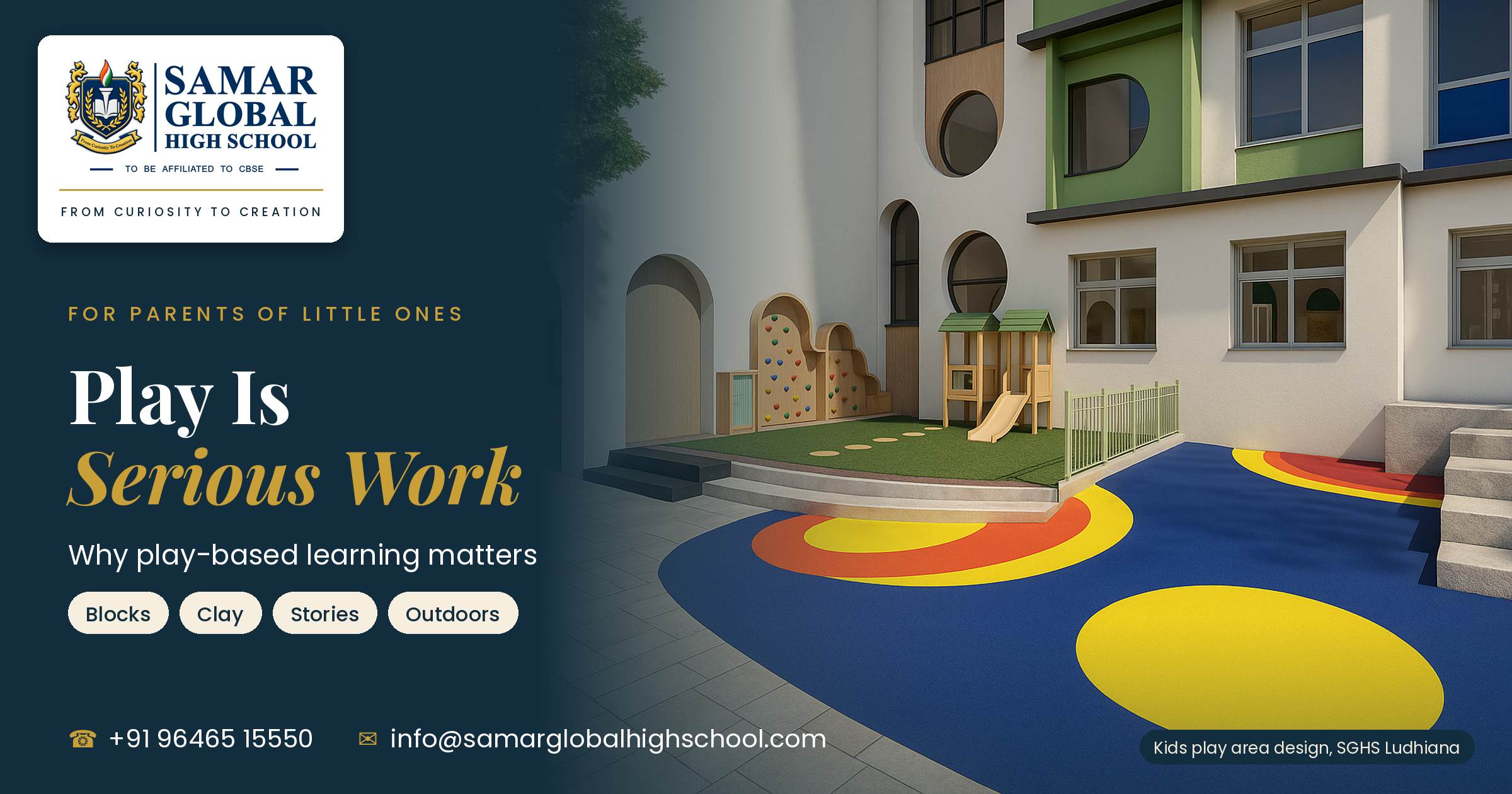
At Samar Global High School, when our first session begins in 2027-28, our Nursery, LKG and UKG children will spend time in the Toddler Corner, the Indoor Sensory Zone and our indoor and outdoor play areas. The Science Park will let them learn from leaves, shadows and puddles. Clay work in the pottery studio and music and movement in the performing arts rooms will be part of the week, not extras. Each child will also have a digital portfolio, so parents can see small steps of growth over time. You can read more on our kids play area and academics pages.
Simple play ideas for home this week
You do not need expensive toys. Most of the best learning happens with things already in your kitchen.
- Roti shop: give your child a small ball of atta and let them roll, shape and “sell” rotis to the family. Count them together.
- Sorting game: mix up spoons, bowls and katoris and ask your child to sort them. Then sort again by size.
- Story with a twist: tell a story and stop in the middle. Ask, “What happens next?”
- Park challenge: at the park, ask your child to find three round things, two rough things and one yellow thing.
- Water play at bath time: a cup, a spoon and a small bottle can teach full, empty, more and less.
Try to keep screens out of these moments. Our blog on screen time for kids has ideas for swapping screen time with play time, and learning beyond textbooks explains why activities matter as children grow.
Frequently asked questions
What is play-based learning in Nursery?
It is a way of teaching where children learn through planned play such as blocks, clay, stories, pretend games and outdoor activities. The teacher sets up the play with a learning goal in mind and guides children while they play.
Will play-based learning delay reading and writing?
No. Play builds the talking, listening and finger strength that reading and writing need. Children move to letters and writing step by step, when they are ready.
How can parents support play-based learning at home?
Give your child simple materials like dough, spoons, boxes and storybooks, play along for a few minutes a day, ask open questions, and keep screens away during play time.
Come and see where it will happen
The best way to understand play-based learning is to talk it through with us. Visit our campus with your child, see the spaces we are preparing for our youngest learners, and ask our team exactly how a Nursery day will look. Admissions for 2027-28 are open from Nursery to Class 5. Book a campus visit or see the admissions page for the steps. We look forward to meeting you both.